> BLOG
By Jakob Bronebakk, Co-founder of Velocity North
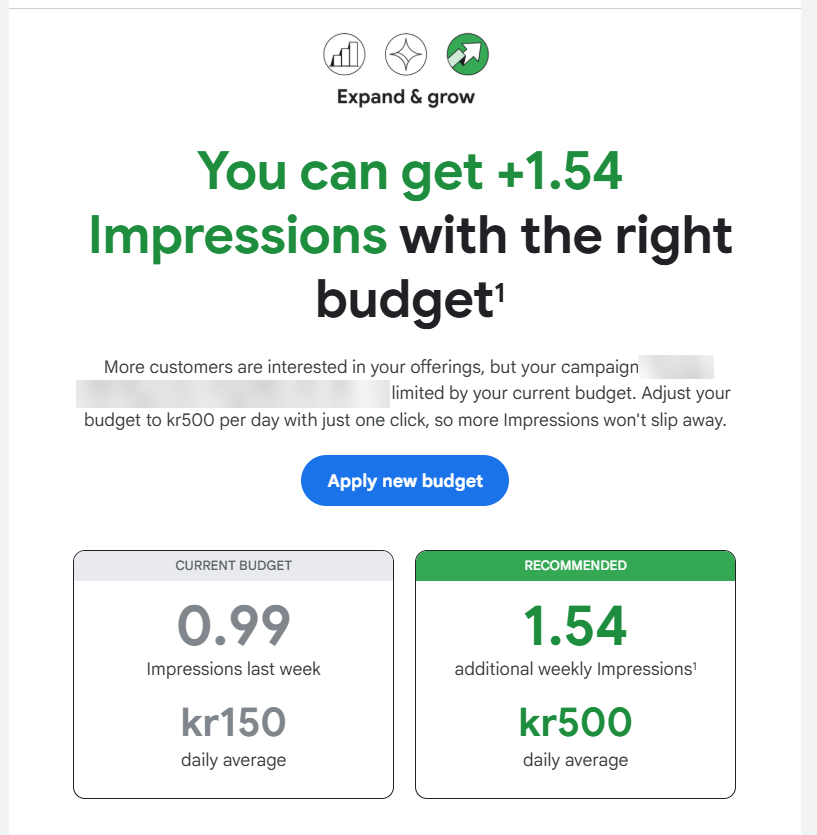
A while ago Google Ads showed one of our newest clients a recommendation. It had a green badge that said “Expand & grow,” a cheerful upward arrow, and a single blue button: Apply new budget. I want to walk through the actual numbers on it, because they are a small masterpiece.
The maths nobody is supposed to do
Here is what the box proposed. Current budget: kr150 a day, producing 0.99 impressions last week (we took this over from an agency that, as you can tell, wasn’t doing a great job).
Recommended budget: kr500 a day, for “+1.54 additional weekly impressions.”
Read that again slowly. Google was asking this client to spend an extra kr350 a day — about kr2,500 a week — to buy 1.54 more impressions. Not 1.54 more conversions. Not 1.54 more clicks. Impressions. The cheapest, most abundant, least meaningful unit in the entire system. The thing that happens when an ad is merely shown to someone.
That works out to roughly kr1,600 per additional impression, or about kr128,000 a year for somewhere near eighty extra impressions. You could not design a worse trade if you tried. And yet it is presented as growth — green, upward, frictionless, one click away.
I don’t think this is a bug. I think it is the product working exactly as intended.
Cui bono (optimisatio)?
We talk about ad platforms being “AI-optimised” as if that settles the question of whether they’re good for you. It doesn’t, because optimisation is meaningless until you ask: what is being optimised, and for whose benefit.
Google’s recommendation engine is genuinely sophisticated. It is also pointed at a target, and that target is Google’s revenue. Its job is to find the largest budget increase a given advertiser can be nudged into accepting, package it in the language of opportunity, and reduce the friction of saying yes to a single tap. By that standard, this recommendation is excellent. It is superbly optimised. Just not for the person paying.
This is not a conspiracy and it isn’t even dishonest, exactly. The numbers are right there on the card. It is simply what happens when the company recommending how much you should spend is the same company you’re spending it with. The incentive is structural. You don’t get to opt out of it by being clever, and you certainly don’t get to opt out of it by clicking “Apply.”
Why this gets more dangerous, not less
For years a recommendation like this just sat there waiting for a human to notice it was absurd. That was the safety mechanism: somebody had to actually click the button, and most somebodies, given a second to think, wouldn’t.
That second is now being removed. The same platforms are shipping AI agents that read these recommendations and act on them automatically, in the name of efficiency. An agent wired into the account, told to “improve performance,” sees a card labelled Expand & grow with a confident green number and does the obvious thing. It applies the budget. The slot machine has been handed the authority to pull its own lever, and it will pull it every hour of every day without once asking who benefits.
This is the whole problem with letting a platform’s native AI run your spending. It is not that the AI is stupid. It is that its loyalties are not yours, and automation removes the one moment where a human might have caught it.
What we do instead
This is exactly the gap Velocity North is built to sit in. We don’t take the platform’s word for what’s working, and we don’t let the platform decide what to do about it.
Two things make that possible. First, an independent read on reality: our conversion data comes from Digtective’s server-side tracking, so we’re measuring what actually converted rather than what Google would like to take credit for. Second, automation that answers to the client’s P&L instead of the platform’s. Our system, Swarm, would look at a recommendation like this one, weigh kr2,500 a week against 1.54 impressions, and decline — and where the call is consequential, a human signs off before anything moves. The button should require a reason, not a reflex.
The point isn’t that platform AI is the enemy. It’s that “Apply new budget” is a recommendation from a counterparty, and you should read it the way you’d read any pitch from someone who profits when you say yes.
So before you let anything automated touch your budget — theirs or your own — ask the one question the green badge is designed to stop you asking. Optimised for whom?